
Master of Business Administration

Build What’s Next with an MBA
Are you ready to advance your career, move into leadership, change fields or launch your own business? An MBA from University of Detroit Mercy will help you develop the knowledge, confidence and professional skills to pursue your goals and create new opportunities throughout your career.
You’ll graduate with more than a respected degree. You’ll build the leadership skills, business expertise and cultural awareness needed to succeed in today’s competitive global marketplace. Grounded in Detroit Mercy’s Jesuit and Mercy traditions, the program emphasizes ethical decision-making, social responsibility and leadership that serves others. You’ll be prepared to make sound business decisions, lead with compassion and create a positive impact in your organization and community.
Small classes provide personalized attention and meaningful interaction with professors who are invested in your success. Our accomplished faculty bring extensive academic and professional experience to the classroom and work closely with you as you pursue your research interests, career objectives and professional growth.
Choose from a wide range of graduate concentrations to tailor your MBA to your interests and career goals.
Choose your area of focus
-
Graduate Program Concentrations
Accounting Analytics
Accounting information systems play an essential role in organizing, analyzing, and safeguarding financial data. This concentration prepares managers to use accounting data, information systems, and analytics software to identify patterns, assess risk, support decision-making, and address issues related to auditing, fraud, and organizational controls.
Artificial Intelligence
AI is among the most disruptive technologies ever developed; it has the potential to increase productivity exponentially and also introduces social and environmental concerns. Learn how to effectively harness its power and limit risk to gain a competitive edge, while earning our nationally ranked MBA.
Business Intelligence
In a world of artificial intelligence and other emerging technologies, businesses need to carefully manage data and decision-making processes; learn how this can be accomplished efficiently and effectively.
Business Turnaround Management
Managing and reviving an organization in distress requires different skills and techniques, and brings different rewards, than managing a stable or growing institution. This concentration focuses on making firms sustainable and positioning them for success.
Financial Accounting
This concentration strengthens managers’ understanding of accounting principles and their application in complex business settings. It prepares MBAs to interpret financial information, support sound business decisions, and pursue roles that require advanced financial accounting knowledge.
Human Resource Management
An essential asset of any organization, and a crucial input to any production process, is personnel. Learn how to effectively hire, professionally develop, promote, compensate, and incentivize employees to achieve organizational goals, in both unionized and nonunionized environments.
International Business
Nearly all modern organizations operate in a global environment, with raw materials, production, employees, and/or customers abroad, and they are influenced by trends and fluctuations in populations, exchange rates, investment opportunities, geopolitical constraints, tariffs, and cultural differences. Become adept at managing an organization in the global context, bridging differences in languages, time zones, social norms, and laws.
Management
Gain expertise in establishing a clear organizational mission and vision, competitive analysis, strategic planning, executing goals and objectives, progress tracking, innovating, and celebrating achievements, all while navigating a complex and changing economic, legal, regulatory, political, and social environment.
Marketing
Learn to use best practices and emerging technologies to conduct market research, develop products and services that resonate with consumers, establish appropriate pricing, promote products and services successfully, and track sales to achieve organizational objectives.
Supply Chain Management
Learn the logistics of bringing raw materials from widely dispersed locations into a common production process, and distributing output through various channels (direct-to-consumer, through wholesalers and/or retailers, etc.) to end users who may also be geographically dispersed.
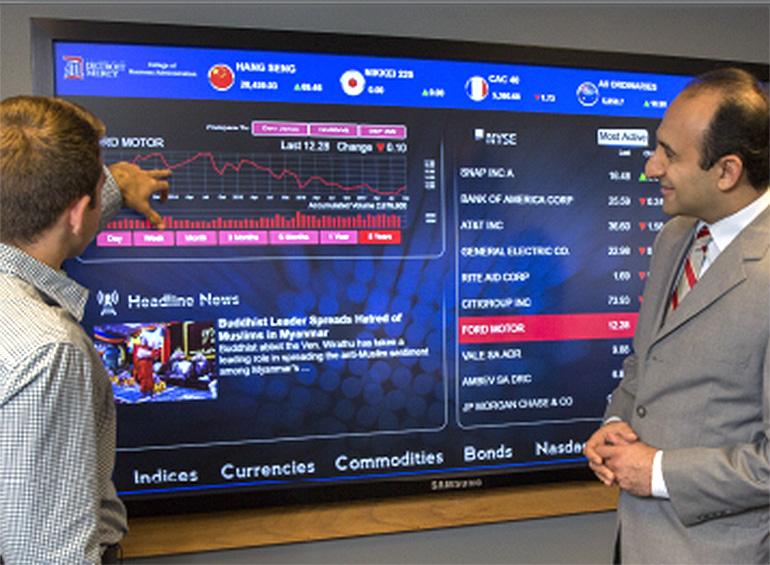
Nationally-Ranked & AACSB Accredited
Detroit Mercy’s MBA program has consistently been ranked among the nation's top 30 Management programs by U.S. News & World Report. In addition, the program is one of only two private universities in Michigan with an AACSB accreditation. Fewer than 5 percent of business schools worldwide have earned this respected distinction.
 "There's that [online] flexibility, but at the same time, you feel like you're actually in class."
—Reem Karimyar, MBA '26
Medical Translator at Linguava in Portland, Oregon.
Tailored To You
This program is not a one-size-fits-all. We have developed options for you to work at your own pace from wherever you feel most comfortable.
- Online: We have online course options to fit your schedule.
- Two campuses in Detroit: If you'd like to experience the city of Detroit, you can choose between McNichols Campus and downtown Riverfront Campus.
- Evenings and weekends available: For greater flexibility, evening and weekend schedules are also available.
In addition to fall and winter semesters, two accelerated 7-week summer sessions are available that allow you to complete the program in as little as one year. Even if you decide to move out of state, we are members of the Network of MBA Programs at Jesuit Colleges and Universities. This partnership provides you with the ability to transfer graduate credits and complete your MBA degree at other Jesuit universities across the country.

 "If you want to see the knowledge acquired be a force for good, I truly cannot recommend any other place than right here, because it's not only encouraged, but each professor I have had ensures that their curriculum has some type of ethical component to it. Professors make sure that it's 1% textbook, 99% projects/real-world simulations, making you do things outside of the classroom that apply those concepts of business to the real world."
—Ivy Nisha Miah, MBA '26

Increase Your Return on Investment
Earning an MBA from one of the nation’s top ranked programs will significantly increase your earning potential. Our program cost brings extraordinary value to your career for years.
Detroit Mercy has strong ties to metropolitan Detroit's business community and our global network of more than 88,000 alumni.
Our graduates populate board rooms and executive offices of major companies, governments, and nonprofits worldwide.

 I knew that I made the right decision choosing the University of Detroit Mercy within my internships. ...Working through the internship, I would think to myself, "Wow, I'm so happy I came here". ...I recommend the University of Detroit Mercy to really anyone that wants to have a good college experience. ...I had the best years of my life here.
—Noor Al-Khafaji, MBA '23
Senior Asset Manager,
City of Detroit

Choose Your Path
The program allows students to individualize their program in specific areas of Accounting Analytics, Artificial Intelligence, Business Intelligence, Business Turnaround Management, Financial Accounting, Human Resource Management, International Business, Management, Marketing and Supply Chain Management.
We even offer a joint MBA/JD program, enabling students to complete both degrees in approximately four years.

Important Connections
In addition to accessing Detroit Mercy's professional network, you will also have the opportunity to make strong connections with your classmates and faculty. Here, you will be able to learn alongside students from around the world, build lasting relationships, and stay connected long after you graduate.

Global Perspectives
As a global city and the center of the world automotive industry, Detroit provides numerous local resources for international perspectives. We partnered with 24 other Jesuit business schools to develop the first recognized foreign MBA program in Beijing, China. In addition, intensive courses with an emphasis on global business are offered during the summer in England, Ireland, China, Brazil and Mexico.
-
Admission Requirements
This information is from the current Graduate Academic Catalog
The MBA program is open to students of high promise who have earned a baccalaureate degree from an accredited college or university. No prior academic work in business is required. Admission decisions are based on undergraduate grade point average (GPA), work experience, post graduate studies, and recommendations, and GMAT (if needed).
Admission Materials
Admission decisions are based on an undergraduate GPA, GMAT score (if needed), work experience, and other degrees.
- Complete the Online Application;
- Official transcripts for all previous academic work;
- A resume;
- Letter of Recommendation (included in the online application); and
- Applicants are welcome to include any other information they feel is important to the admission consideration. This information can be uploaded while completing the online application.
-
Degree Requirements - Master of Business Administration (33 credits)
This information is from the current Graduate Academic Catalog
Core Courses
- ACC 5200 Managerial Accounting (3 credits)
- MBA 5200 Modeling, Analytics, and Operation Decisions (3 credits)
- MBA 5210 Personal Development, Ethics, and Social Responsibility (3 credits)
- MBA 5220 Strategic Financial Management (3 credits)
- MBA 5240 Marketing Management and Planning (3 credits)
- MBA 5250 Teamwork and Shared Leadership: Enhancing the Creative Process in Organizations (3 credits)
- MBA 5260 Systems and Technology (3 credits)
Post-Core Courses
- MBA 5900 Strategic Management and Innovation in a Global Economy (3 credits)
- Advanced Electives* (9 credits)
* The nine hours of advanced electives (beyond foundation and core) are aimed at providing an elective route for all MBA students. Core electives shall consist of selecting three (elective) courses from the following:
ACC 5300 – ACC 5950
BTM 5000 – 5999 (excluding BTM 5500)
MBA 5270– MBA 5990 (excluding MBA 5900)
Total required credits: 33 credits
-
Do I need the GMAT?
1. Was your undergraduate grade point average 3.0 or above?
2. Do you have 7 or more years of professional experience?
3. Have you already earned a graduate or professional degree?If you can answer “YES” to at least two of these questions, then you have an excellent chance to gain admission to the AACSB accredited MBA program at University of Detroit Mercy WITHOUT TAKING THE GMAT! Otherwise, you should plan to submit official scores from either the Graduate Management Admission Test (GMAT) or Graduate Record Exam (GRE).